| The European spacecraft Juice (Jupiter Icy Moons Explorer) launched on 14 April 2023 and is planned to enter the Jupiter system on 21 July 2031. Xxxx xxx xxxx xxx. My participation on the mission began in 2020 xxxx xxx xxxx. | Die europäische Raumsonde Juice (Jupiter Icy Moons Explorer) wurde am 14. April 2023 gestartet und soll am 21. Juli 2031 in eine Umlaufbahn um den Planeten Jupiter einschwenken. Xxxxx xxxx xx xxxx xxx. Xxxxx xxxx xx xxxx xxx. Meine Mitarbeit an der Juice-Mission begann im Jahr 2020 xxxx xxxx xxxx. Diese Seite gibt eine Übersicht (auf englisch). |
Xxxxx 0 xxx Juice xxxxx xxxx.

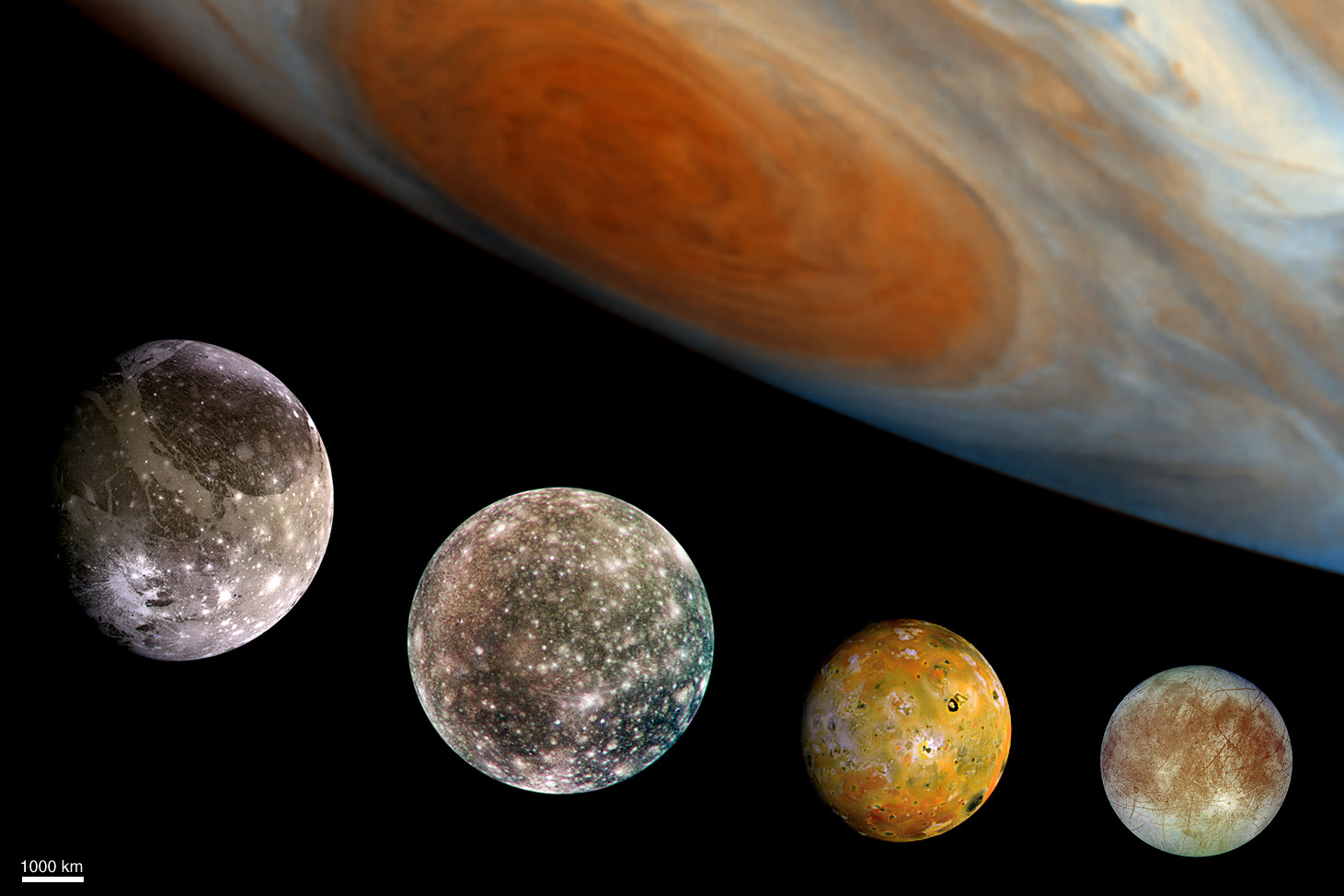
Fig. (middle): Anti-Jovian hemisphere of Ganymede as seen by the Voyager-2 spacecraft.
Fig. (right): Jupiter and the four Galilean moons Ganymede, Callisto, Io, and Europa.
This website gives a short summary of interesting aspects of the Juice mission in compact form. With new information coming in, it will be updated regularly. A reference list with weblinks and scientific papers for more in-depth reading is provided at the last sheet of this page.
Last update: 02 Jun 2023 — page content is best displayed on a screen at least 1024 pixels wide
(1) Featured
• Images: ESA Multimedia
• [26 May 2023] Some of the first JANUS images show η Cygni (EtaCyg)
• [14 Apr 2023] Launch! xxx
• [26 Nov 2020] Some YouTube videos on the making of Juice: Episode 1 — Episode 2 — Europe goes to Jupiter
• [18 Aug 2020] The laser altimeter GALA started its Twitter account — link here.
• [07 Apr 2020] Transport of flight hardware to Airbus/Friedrichshafen xxxx xxx.
(2) DLR participation
Xxxxx 2 xxxx xxxx.
JANUS camera
JANUS on Juice site at DLR → link
JANUS: IFOV = 15 µrad => = 3.094″
(Cassini was 2.48″ in 2sum mode).
GALA laser altimeter (link)
(3) Mission timeline
Xxxxx 3 xxxx xxxx.
All information subject of change
Launch: Fri 14 Apr 2023. Launcher: Ariane 5 (Kourou, Guyane (French Guiana))
Cruise – Flybys table
https://pbs.twimg.com/media/C7hd55fXUAEQSPV?format=jpg&name=900×900
https://www.esa.int/ESA_Multimedia/Videos/2017/03/Juice_s_journey_to_Jupiter
JOI & 1G1: 21 Jul 2031
Orbit tour – Mission phases table
Ganymede orbits (GOI: 20 Dec 2034)
Fig.: Cruise; Orbit tour; Ganymede
http://www.esa.int/ESA_Multimedia/Videos/2019/01/Juice_s_Jovian_odyssey#.XqF8vrQTnfM.link
(4) Spacecraft and instruments
Xxxxx 4 xxxx xxxx.
https://airbus-h.assetsadobe2.com/is/image/content/dam/products-and-solutions/space/space-exploration/juice/JUICE-infographic.jpg?wid=3626&fit=constrain
Size, weight
Scientific instruments (table)
(5) Science objectives
Xxxxx 5 xxxx xxxx.
Juice has two major science themes:
1. Emergence of habitable worlds around gas giants
2. Jupiter system as an archetype for gas giants
Ganymede
Europa
Callisto
Jupiter (atmosphere, magnetosphere, interior)
Jupiter system (Io, rings, small inner moons, Irregular moons)
xxx
(6) Mission leadership
Xxxxx 6 xxxx xxxx.
ESA
Project Manager: Giuseppe Sarri
Mission Manager: Nicolas Altobelli
Project Scientist: Olivier Witasse
Imaging (JANUS) PI: Pasquale Palumbo, Thomas Roatsch
Fig. Missionslogo (klein)
(7) Footage from ESA
Xxxxx 7 xxxx xxxx.
Juice’s cruise through the inner Solar system to Jupiter (55 sec):
Juice’s cruise to Jupiter, orbit tour, and final destination Ganymede (9:27 min):
(8) History/events
Xxxxx 8 xxxx xxxx.
• [16-18 May 2023] First turn-on and images of JANUS camera
• [14 Apr 2023] Juice launch (ESA press release)
• [00 Xxx 201x] xxx
• [02 May 2012] Juice selected as ESA’s next large science mission (ESA press release)
(9) Links, references, acknowledgments
♦ Links outside
Wikipedia —  Jupiter Icy Moons Explorer
  JUICE (Raumsonde)
Wikipedia — Galilean moons Galileische Monde
Wikipedia — Jovian moon Europa (moon) Jupitermond Europa (Mond)
Wikipedia — Jovian moon Ganymede (moon) Jupitermond Ganymed (Mond)
Wikipedia — Jovian moon Callisto (moon) Jupitermond Kallisto (Mond)
Juice at ESA: mission homepage • science homepage • Images/ESA Multimedia
Juice-Seite am DLR Institut für Planetenforschung in Berlin
JANUS on JUICE site at DLR
Juice-Texte (von mir verfasst) für die interessierte Öffentlichkeit → Readings/Lesestoff-Seite
♦ References (alphabet-ordered)
  |
Grasset, O., Dougherty, M.K., Coustenis, A., Bunce, E.J., Erd, C., Titov, D., Blanc, M., Coates, A., Drossart, P., Fletcher, L.N., Hussmann, H., Jaumann, R., Krupp, N., Lebreton, J.-P., Prieto-Ballesteros, O., Tortoram, P., Tosi, F., Van Hoolst, T. (2013): JUpiter ICy moons Explorer (JUICE): An ESA mission to orbit Ganymede and to characterise the Jupiter system. Planetary and Space Science 78, 1-21. doi:10.1016/j.pss.2012.12.002. |
|
Khurana, K.K., Pappalardo, R.T., Murphy, N., Denk, T. (2007): The origin of Ganymede’s polar caps. Icarus 191, 193-202. doi:10.1016/j.icarus.2007.04.022. |
♦ Acknowledgments
I am very grateful to the following institutions and persons without whom I would never have been able to conduct this work:
• DLR (Deutsches Zentrum für Luft- und Raumfahrt) in Berlin-Adlershof — they gave me leave to work with Cassini/Saturn at Freie Universität (FU) Berlin for 16 years, and now (since January 2020) employ me again for working in the Jupiter system.
• Gerhard Neukum (DLR until 2002, then FU Berlin) — my original “gate” to the Galileo and Cassini missions and to planetary science at all.
© Tilmann Denk (2025)